Human Condition · Essays
Defining Hope
An exploration of hope and the uncertain boundary between peace and despair.
I recently watched what might be one of the best movies out there - “Project Hail Mary.” The movie (I’m yet to read the book it’s based on) is considered a quintessential example of hopeful science-fiction, and it is absolutely phenomenal. But I’m not here to talk about the movie/book - rather, I’d like to touch on the subject of hope in our lives, since, as a topic, it’s been making a comeback.
“Maintaining hope against all odds” is often praised as an indication of a superior unwavering spirit. A virtue. It’s attributed to heroes and associated with “forces of light” (as if “villains” of the world don’t have hopes of their own). Hope is what gives a greater weight to singular anecdotes over statistics in our own minds. Hope is what is presumed to hide behind optimism, which is associated with a better quality of life (and mental states). But just like with empathy, not all hope is created equal and I think it’s important to address that, so we can stop prescribing hope as another false panacea.
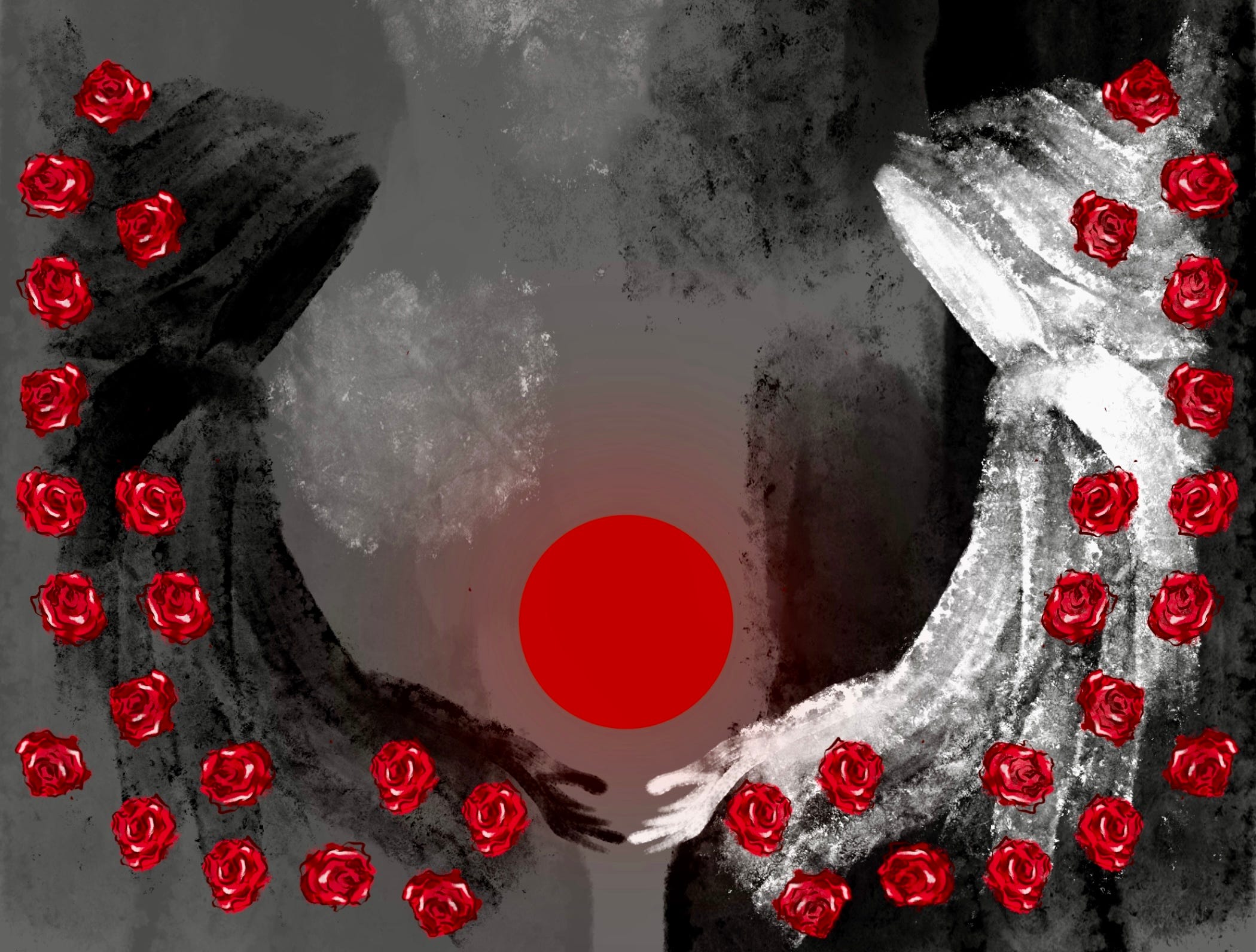
You know how at some point we all arrive at the realization that the opposite of love is not hate but indifference? What do you think is the opposite of hope? For the longest time, I was convinced it was despair. I even wrote and illustrated a whole book on that journey from light to darkness - “Ode to Hope and Despair.” Then, once the book was finished, I realized something. Yes, the reverse of hope is hopelessness, and desperation is synonymous with hopelessness. But despair is not the reverse of hope. Despair is just hope gone bad. Despair is the awareness of the possibility of hope unsupported by any belief in it. It arises when hope fails to lead to anything. Because hope isn’t supposed to be the destination - it’s just a gateway, a passage, a conduit - and getting stuck there can prevent life from happening.
In this, hope can be considered a reactant, or more specifically - the activation energy. Hope fuels possibilities. Would we take actions directed at a change, if we didn’t hope that they could lead to something? Of course, actions can be taken out of belief in a successful outcome too, but belief is higher on the hierarchy of conviction than hope, meaning that hope requires less (energy) input. This kind of makes hope a minimum threshold for action potential.
But hope can also turn life into emotional swings. In addition to possibilities, it can also fuel fantasies and even delusions. I touched on this a little in one of my earlier pieces (Manifesto on Love), when discussing the hope-incited agitation: “… in a way, the certainty of loneliness and unhappiness associated with it was bringing more relief and peace than clinging on to a meager possibility of family and happiness. That was when I first conceived of the idea that the opposite of hope isn’t despair but peace.” In that essay, I talked about how eliminating hope entirely led to the erasure of expectations, which also meant no disappointment - it became an imitation of peace through the certainty of a negative outcome through choice. So, it should be no surprise that there used to be a time when between the agitation of painful hope and tranquility of safe resignation, the choice seemed obvious.
When hope is gone, you give up. Surrender. Then the opposite of hope is acceptance. Resignation. Tranquility. Equanimity. The knowledge that whether I continue to fight or not, it’s okay either way - I’ll manage. It’s anything and everything that stops the inner turmoil of holding on to a possibility and preventing one’s life from moving on.
So yes, you read it correctly: the opposite of hope is not despair - it’s peace. How about that? When this first occurred to me, it seemed like a very obvious but also provocative realization. But something felt missing. Based on my observations, it seemed there were two types of hope: to one, peace was an epitome, and to the other, it was an antithesis. So I tried to plead my case formulaically, and that led to a more refined understanding of this relationship.
(SN: I haven’t done equations since college, so bear with me here.)
Given:
Hope = H
Despair = D
Peace = P
rotten (unhealthy/bad) = r
blooming (healthy/good) = b
opposite = “-”
Assuming:
bH = -rH (blooming, healthy hope is the opposite of rotten, unhealthy hope)
P = -rH = -D (peace is the opposite of both rotten hope and despair)
rH —> D (rotten hope leads to despair)
bH —> P (blooming hope leads to peace)
We get:
If H —> D, then H = rH
If H —> P, then H = bH
In other words, if the hope in our life creates despair, that’s unhealthy hope and we’ll benefit from reframing/transforming it. Because apparently, peace is not the opposite of all hope - peace is the definition of healthy hope, or at least a sign/symptom of it. This set of equations isn’t very useful though because it requires an outcome to make a determination of the type of hope rather than allowing us to identify it at the outset in order to adjust towards a desirable outcome. Any thoughts on how to get there? (serious question)
There are a lot of examples of hope going bad. Unhealthy hope. Wars and genocides are teeming with such stories. Some of those that impacted me the most were outlined by Auschwitz survivors. They observed how people whose hope was tied to specific outcomes, such as “to be freed by Christmas,” were more likely to fall into despair when the outcome didn’t materialize, and in their despair, give up on trying to survive and die. Edith Eger noted in her books that real (healthy) hope frees you to act now, untied from any particular outcome. Maybe this is where we get closer to differentiating between healthy and unhealthy hope: one is fuel for action and grounded in flexibility while the other is attachment to outcome and grounded in expectation?
Unhealthy hope keeps you stuck in a cycle of despair. Despair caused by the regular rejections of reality in favor of sustaining a delusion. Or rather, despair caused by the regular “attacks” by that reality on the “integrity” of the hope-sustained delusions.
“He’ll change.”
“She’ll come back.”
“No bodies means that they are still alive.”
You know, the types of hopes that are in essence opiates abused as painkillers. I’m not trying to discount their utility - we all need them here and there in order to cope with the occasionally gruesome reality. It’s when they lead to sustaining that reality and putting one’s life on hold rather than taking action in the direction of those hopes that we start to have a problem. So, how do we determine which hope we have?
It’s not foolproof, but my litmus test for whether my hope is healthy or not has been to subject it to the Litany of Gendlin:
“What is true is already so.
Owning up to it doesn’t make it worse.
Not being open about it doesn’t make it go away.
And because it’s true, it is what is there to be interacted with.
Anything untrue isn’t there to be lived.
People can stand what is true,
for they are already enduring it.”
(SN: This is already the second time I’m referring to this litany in an essay, so you can see that I’m serious about it.)
This way, I can hope for a different/better reality/life, while acknowledging that the “non-different/non-better” one I experience right now is real and I’m already enduring it. There’s no need to hide from it in a delusion because I’m already living it. Hope without acceptance is delusion. And delusion in a way is the origin of despair. Which then leads to these clean but tentative conclusions:
A hope is unhealthy when it requires you to deny present reality in order to sustain it. Unhealthy hope will eventually lead to despair.
A hope is healthy when it allows you to fully acknowledge/accept reality while still permitting the possibility of a different one. Healthy hope brings about peace.
To reiterate, hope in its purest healthy blooming form is the equanimity of allowing a positive possibility into your view of the future. This is what makes “Project Hail Mary” so impactful - it manages to not just remind us about this peace-inducing hope but to actually instill it in us, the viewers, at least for the duration of the movie.
P.S. I’ll leave you with a few coaching questions for your own reflection:
What does this hope give me? What does it take from me (or prevent me from)?
Does this hope require me to ignore what is true right now?
Does it keep me passive, waiting, putting my life on hold?
Does it allow me to act, even without guarantees?
Do I consider a life without this hope unbearable?
P.P.S. The image is from that very illustrated poetry book “Ode to Hope and Despair” I referenced above.
AI disclosure: ChatGPT was leveraged to pull up some definitions and check for grammar/spelling/punctuation.
Originally published on Human Condition on Substack.
Join the conversation
Leave a comment
Your comment will appear after review. Please avoid sharing private information.